Chuck Anderson Jazz Guitar Player Teaching Methods
Chuck develops guitar players into musicians. His specialization is jazz although he works with and develop guitarists in every style. Subjects taught are technique, chord work and applications, improvisation, solo guitar, sight reading, ear training, theory, songwriting and development of performance repertoire and skills.
Chuck methods are customized and drawn from an enormous background of teaching and performing experience.
The private teaching programs are devoted to learning or advancing the Jazz Guitar. Of all the guitar styles, the Jazz Guitar requires the most information, knowledge and technique. That being said, these programs will benefit any guitar player trying to advance his or her skills on the guitar.
Take advantage of my forty five years of teaching and research to help you advance in the art of the guitar.
Visit http://www.HowToLearnJazzGuitar.com for more information!
There are three ways to enroll in private studies. All lessons are customized to your level and to your goals.
1) Private lessons are available at my suburban Philadelphia studio.
This is the most traditional approach – one student – one teacher at my private studio located at 246 E 5th Ave Conshohocken, PA 19428
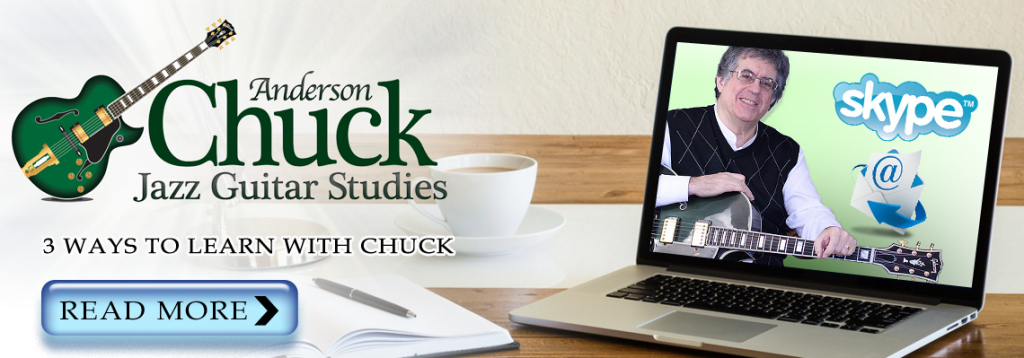
2) The second alternative is Study by Skype.
This is the closest approach to private lessons since we have face to face communications. There are no distance barriers but from a time perspective, it’s not as flexible as the on line program because like a private lesson, specific time has to be scheduled.
3) Jazz Guitar Studies – an online program
If neither the studio nor the Skype Program work for you, the third option is my online program. This is a time shifted alternative which can accommodate virtually any schedule and location. I get the lesson material to you on line – you prepare it. Our communications then involve E mail and/or video exchange. The on line program is currently under development. I’ll announce the launch in the near future.
All three approaches work. It’s really just a matter of convenience for you and your situation. Our goal is simple – get the material you need to you and then monitor and guide your progress.
For more information, you can reach me by E mail at: ChuckAnderson202@comcast.net or by telephone at 610 941 9622.
We can discuss your goals, your level, your schedule and the program that will be best suited to maximize your progress.
For more information and a schedule of fees, contact Chuck Anderson now: Click Here
I’m looking forward to the opportunity to work with you!
-Chuck A.
In order to pursue jazz guitar study, we first have to pursue the guitar itself. Jazz is an advanced form of guitar and is not usually the first introduction to guitar. After the fundamentals of the guitar are covered, let’s look at what jazz guitar lessons involve.
The organization of the subject into categories is a great place to start.
These are the fundamental topics taught in the jazz guitar:
- Technique
- Ear Training
- Theory
- Improvisation
- Melody
- Jazz Chords and their Applications
- Repertoire
- Style
- Phrasing
- Feel
- Pulse
- Tempo
- Harmonic, Melodic and Rhythmic Analysis
- Scales, Arpeggios, Interval Development and Sequences
- Scale and Chord Inversion
- Voice Leading
- Bass Lines
- Accompaniment
- Comping
As you can see, it’s quite a list. Don’t despair! Like the proverbial journey of a 1000 miles, it only requires one step at a time. Nothing is so difficult that it doesn’t have a first step. The biggest problem is organizing those steps.
Of all the guitar based forms, jazz is the most difficult to self teach. The material needs to be customized to help maximize your progress!
For more information on these private studies, visit my educational website at:
or contact me by E mail at:
or by phone at 610 834 0929